
Between 0x2 Nerds Live Stream on Network Complexity

I’m sitting with Jeff Doyle and Jeff Tantsura to talk about network complexity on the Between 0x2 Nerds podcast today at 1PM ET today. The link is here—
https://www.youtube.com/watch?v=iTac5q5SoN0
Join us if you can.
Hedge 103: BGP Security with Geoff Huston

Our community has been talking about BGP security for over 20 years. While MANRS and the RPKI have made some headway in securing BGP, the process of deciding on a method to provide at least the information providers need to make more rational decisions about the validity of individual routes is still ongoing. Geoff Huston joins Alvaro, Russ, and Tom to discuss how we got here and whether we will learn from our mistakes.
Hedge 102: BGP Security with Geoff Huston

Our community has been talking about BGP security for over 20 years. While MANRS and the RPKI have made some headway in securing BGP, the process of deciding on a method to provide at least the information providers need to make more rational decisions about the validity of individual routes is still ongoing. Geoff Huston joins Alvaro, Russ, and Tom to discuss how we got here and whether we will learn from our mistakes.
Keith’s Law (1)

I sometimes reference Keith’s Law in my teaching, but I don’t think I’ve ever explained it. Keith’s Law runs something like this:
Any large external step in a system’s capability is the result of many incremental changes within the system.
Hedge 101: In Situ OAM

Understanding the flow of a packet is difficult in modern networks, particularly data center fabrics with their wide fanout and high ECMP counts. At the same time, solving this problem is becoming increasingly important as quality of experience becomes the dominant measure of the network. A number of vendor-specific solutions are being developed to solve this problem. In this episode of the Hedge, Frank Brockners and Shwetha Bhandari join Alvaro Retana and Russ White to discuss the in-situ OAM work currently in progress in the IPPM Wg of the IETF.
Thoughts on the Collapsed Spine

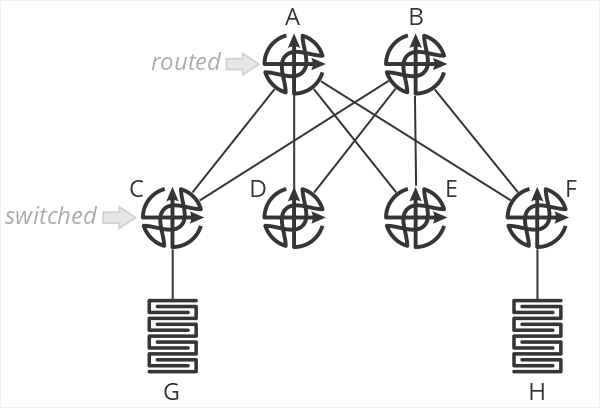
One of the designs I’ve been encountering a lot of recently is a “collapsed spine” data center network, as shown in the illustration below.
Hedge 100: Supply Chain Diversity with Brooks Westbrook and Mike Bushong

Most network engineers don’t spend a lot of time thinking about their supply chain—you must call your favorite vendor, order, and a few weeks later the hardware shows up on your loading dock. It’s not so simple any more. If you disaggregate, you need to manage your software and hardware supply chains separately. You need to think about security in your supply chain—is that software package backdoored? Moving to the cloud might seem to solve these problems, but they don’t. Even virtual networks have physical limits.
Russ’ Rules of Network Design

We have the twelve truths of networking, and possibly Akin’s Laws, but is there a set of rules for network design? I couldn’t find one, so I decided to create one, containing 18 laws I’ve listed below.
Hedge 99

Two things have been top of mind for those who watch the ‘net and global Internet policy—the increasing number of widespread outages, and the logical and physical centralization of the ‘net. How do these things relate to one another? Alban Kwan joins us to discuss the relationship between centralization and widespread outages. You can read Alban’s article on the topic here.
Hedge 098: DRIP with Stuart Card

Drones are becoming—and in many cases have already become—an everyday part of our lives. Drones are used in warfare, delivery services, photography, and recreation. One of the problems facing the world of drones, however, is the strong tie-in between the controller and the drone; this proprietary link limits innovation and reduces the information available to public officials to manage traffic, and even to protect the privacy of drone operators. The DRIP working group is building protocols designed to standardize the drone-to-controller interface, advancing the state of the art in drones and opening up the field for innovation. Stuart Card joins Alvaro Retana and Russ White to discuss DRIP.